The Hidden Cost of SaaS and Tool Sprawl
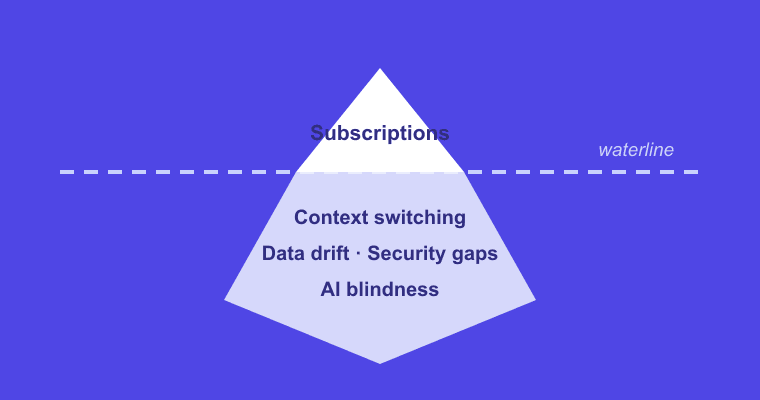
The subscription line on your P&L is the cost you can see — and the smallest.
How sprawl happens (to everyone)
No one plans tool sprawl. A team adopts a tracker because the official one feels clunky. Marketing signs up for a doc tool on a credit card. Someone spins up a second chat app "just for the project". Each decision is locally sensible - and collectively, industry surveys now put the average enterprise at more than 100 SaaS applications, with even small businesses running dozens. Your team likely switches between 10+ apps every day.
The subscription costs add up - for a mid-sized company, easily tens of thousands per year for tools that barely talk to each other. But if subscriptions were the whole problem, sprawl would be a procurement nuisance, not a strategic one. The expensive costs are the ones that never appear on an invoice.
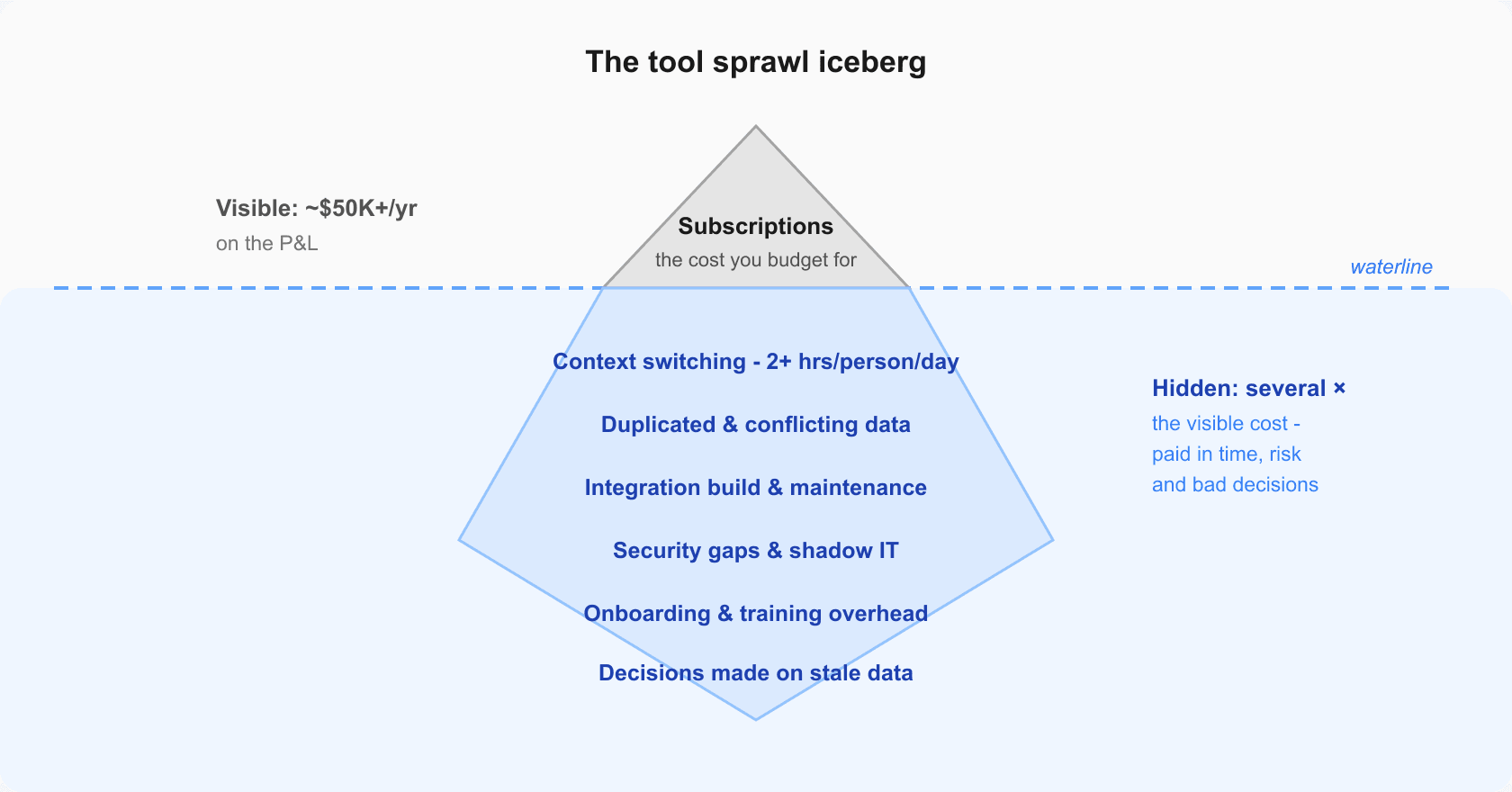
> Key takeaway: Subscriptions are the smallest cost of sprawl. The real bills are fragmented attention, conflicting data, security exposure and AI that can't see your business - none of which appear on an invoice.
The four costs below the waterline
1. Attention. Context switching is the quiet productivity tax. Research on knowledge work has repeatedly shown that employees toggle between apps and tabs over a thousand times a day, and that refocusing after a switch takes real time - commonly estimated at two-plus hours per person per day lost to platform-hopping. Multiply that across a 50-person company and sprawl is consuming the equivalent of a dozen full-time salaries in fragmented attention.
2. Data drift. Every extra tool is another place facts can live - and disagree. Project status in the tracker says one thing, the spreadsheet says another, the deck says a third. Teams spend hours reconciling instead of deciding, and eventually stop trusting reports altogether. (This is the core argument for a single source of truth.)
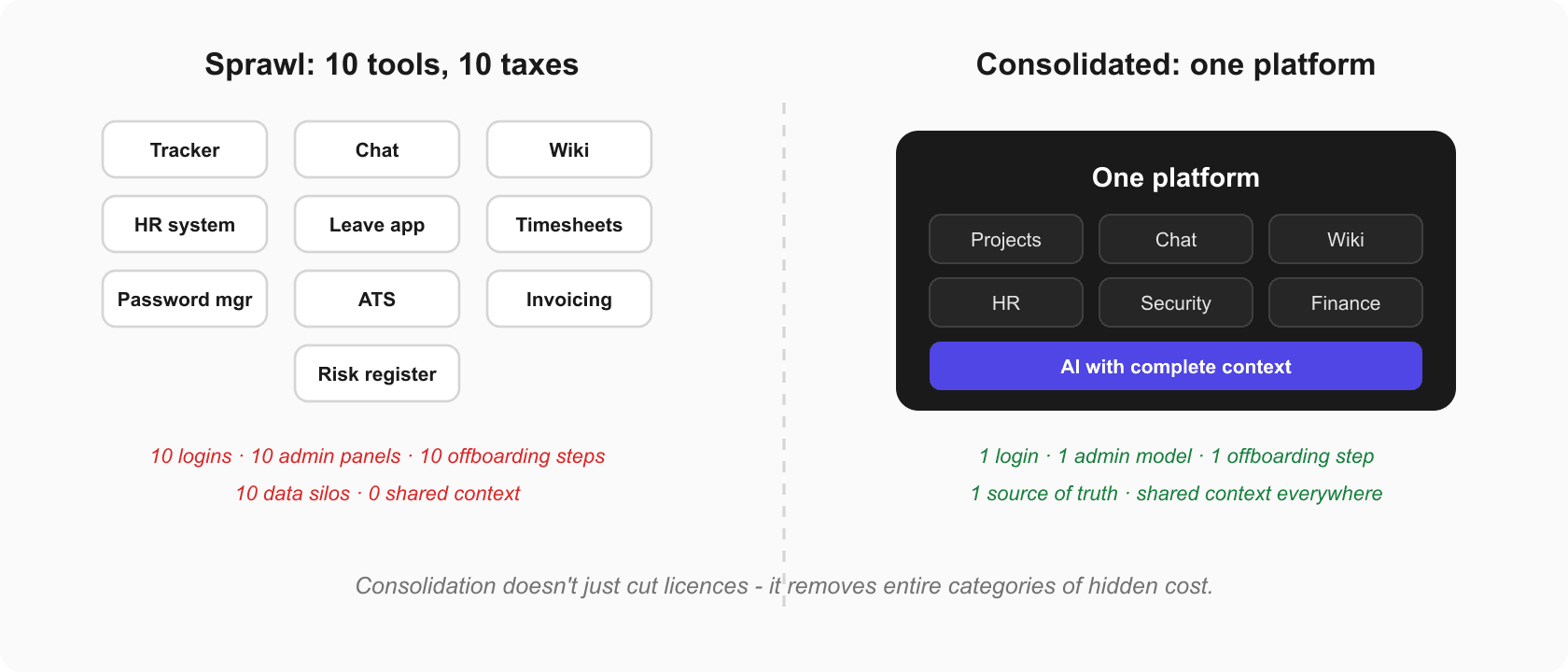
3. Security surface. Every application is another login, another set of permissions, another offboarding step that can be missed. When an employee leaves, can you say with confidence that access was revoked in all 100+ systems? Sprawl turns a simple compliance question into an audit nightmare - and shadow IT (tools nobody officially approved) means the true number of systems is always higher than the official one.
4. AI readiness. The newest cost, and soon the biggest. AI can only reason over the context it can reach. Sprawl means your business's knowledge is shredded across dozens of silos, so any AI you deploy sees fragments and answers accordingly. Companies with consolidated data will compound AI gains; companies with sprawl will keep getting confident answers to partial questions.
Why "just integrate everything" doesn't work
Integration platforms and sync tools promise to make sprawl painless. In practice, each integration is more software to configure, monitor and fix - a new hidden cost layered on the ones above. Syncs fail silently, mappings drift, and the truth now lives in the middleware. Integration has its place, but as a strategy for fixing sprawl it treats the symptom while feeding the disease.
A practical way to audit your own sprawl
Three questions surface the damage quickly. First, how many tools does a status update touch? Follow one "how's the project going?" from question to answer and count the apps involved. Second, how long does offboarding actually take? List every system a leaver must be removed from - the length of that list is your security exposure. Third, what would your AI see? If you connected an assistant today, how much of the business could it actually reach?
If the answers are "five", "we're not sure", and "not much" - sprawl is costing you far more than your subscription report shows.
The consolidation dividend
This is the premise Hplix is built on: projects, communication, knowledge, HR, security and operations in one platform. Fewer licences are the headline saving, but the compounding returns come from below the waterline - attention regained, one source of truth, one access model to secure, and a foundation where AI has complete business context from day one.