AI Assistants vs AI Operating Systems
Every tool now ships an AI assistant. So why does work still feel manual?
The copilot boom - and its ceiling
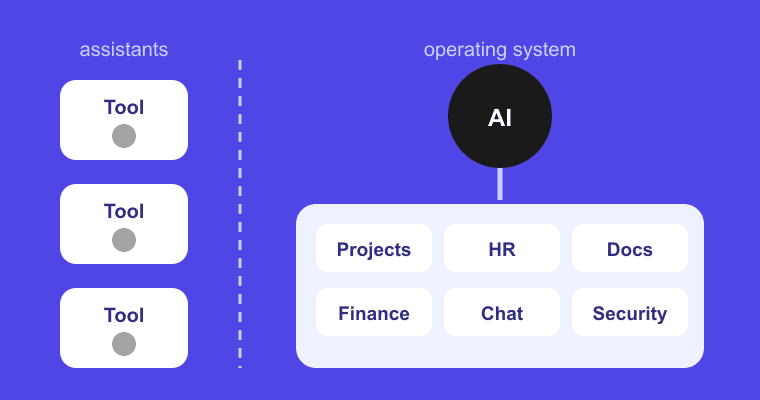
Over the past two years, AI assistants have been bolted onto nearly every SaaS product. Your project tracker can summarise a sprint. Your doc tool can draft a page. Your email client can rewrite a message. Each is useful, and each shares the same hard ceiling: it can only see and act inside its own tool.
Ask the project tracker's copilot whether you can commit to a client deadline, and it will reason beautifully about tasks - while knowing nothing about who's on leave, what the hiring pipeline looks like, or whether a security review is blocking the release. The assistant isn't unintelligent. It's confined.
Stack up ten confined assistants and you get a strange outcome: more AI than ever, and a human still doing the integration work - carrying context between tools, re-explaining the situation in every chat box, and stitching partial answers into a whole one.
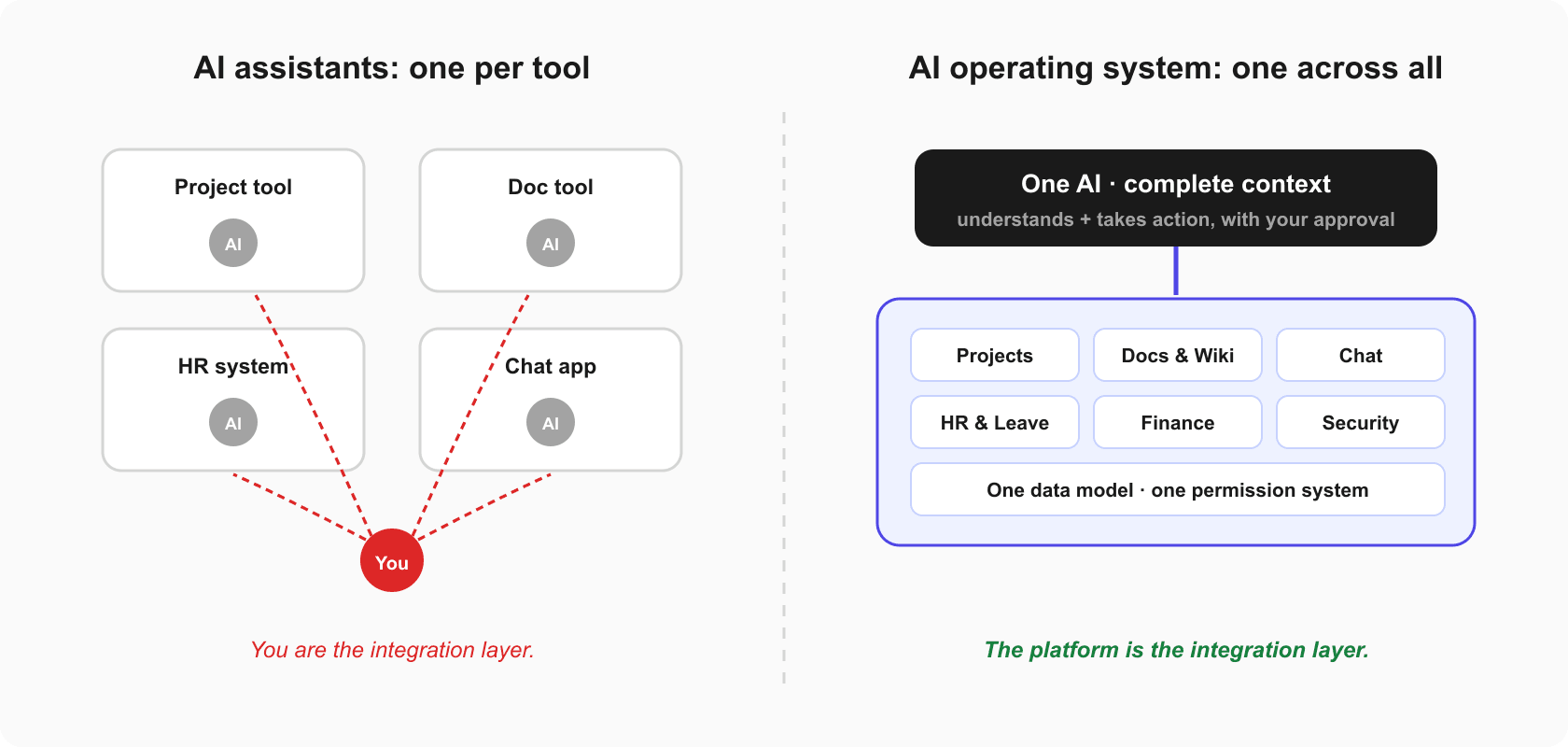
> Key takeaway: Per-tool copilots automate fragments. An AI operating system - complete context, real actions, one governance model - automates workflows end to end.
What makes something an AI operating system?
An operating system, in the classic sense, is the layer that gives every program shared access to the machine's resources. An AI operating system for business plays the same role for work: it gives AI shared, governed access to the resources of the company - its projects, people, knowledge, finances and security posture - so intelligence can be applied anywhere, not in one app at a time.
Four tests separate a true AI operating system from an assistant with good marketing:
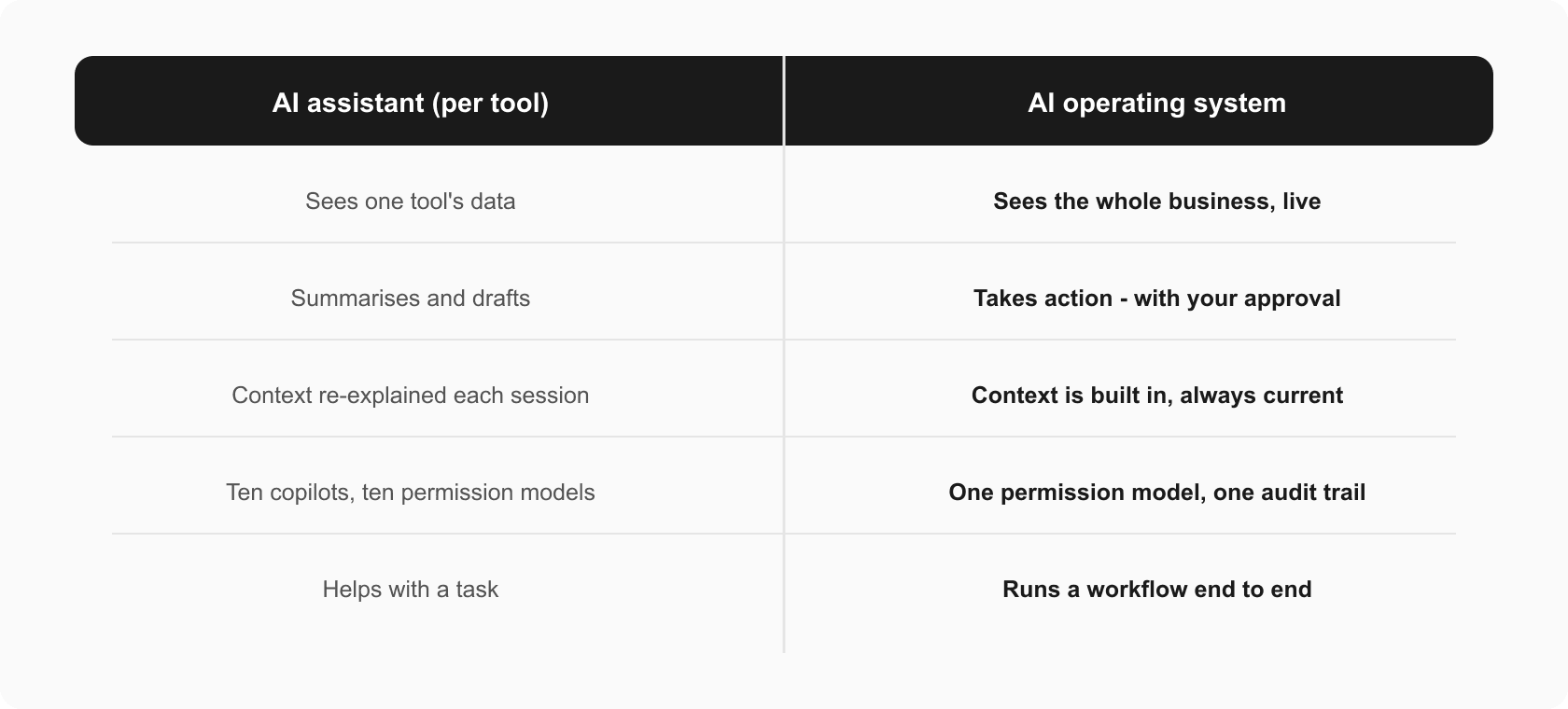
- Scope - Can the AI answer questions that span functions ("can we staff this project given current leave and hiring?"), or only questions about one tool's data?
- Action - Can it do things across the business - create tasks, approve leave, raise invoices - or only summarise and draft?
- Liveness - Does it work from current operational state, or from indexed documents and exports?
- Governance - Does it respect one permission model, keep one audit trail, and require human approval for writes - or does each embedded copilot bring its own rules?
Most embedded copilots fail at least three of the four. Not because they're badly built, but because the architecture underneath them - a sprawl of disconnected tools - makes passing them impossible.
Side by side
What this looks like in practice
Picture a Monday morning. Instead of opening six tabs, a CEO asks one question - "what needs my attention today?" - and gets a briefing drawn from live data: two projects at delivery risk, a key renewal due this week, hiring behind plan in engineering, no critical security issues. A project manager asks for a standup summary across all projects. A HR lead reviews and bulk-approves routine leave requests in one confirmation. Each of these crosses tool boundaries that would stop a per-tool copilot cold.
This is how Pulse, the AI command centre in Hplix, works - because Hplix runs projects, communication, knowledge, HR, security and operations on one platform, Pulse starts with complete context and one governance model. And through Hplix MCP, the same complete context is available to any LLM you already use, from Claude to ChatGPT, with every write action requiring your explicit approval.
Assistants were the preview. This is the platform shift.
Per-tool assistants proved that people want AI in their work. But intelligence confined to silos can only ever automate fragments. The real shift - the one that changes how a business runs - happens when AI sits on top of a unified foundation with complete business context: an operating system, not a feature.