Why AI Needs Complete Business Context
AI connected to one-tenth of your business gives one-tenth of an answer.
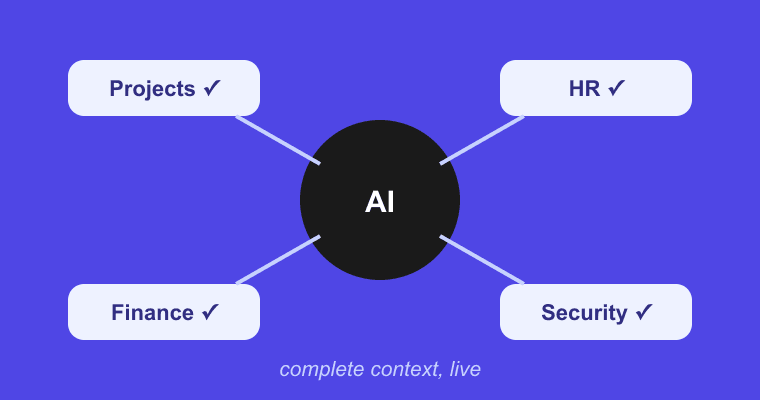
The model isn't the bottleneck. Context is.
Modern language models can reason, summarise, plan and draft at a level that would have seemed implausible a few years ago. Yet most businesses that roll out an AI assistant end up mildly disappointed. The assistant writes nice emails but can't tell you which projects are at risk. It summarises a document but doesn't know the document was superseded last month.
The gap is rarely intelligence. It's visibility. An AI can only reason over what it can see, and in a typical business, what it can see is a sliver: the one tool it's embedded in, or whatever text a user pastes into the chat box.
Business questions cross tool boundaries
Consider a question any operations lead asks weekly: "Can we take on this new client project next month?"
Answering it properly requires project timelines and current workload, team capacity and approved leave, hiring pipeline status, and any security or compliance constraints the client brings. That's four or five different systems in a typical company. An AI assistant embedded in just one of them can only answer a fraction of the question - so it either refuses, or worse, answers confidently from partial data.
Fragmented context doesn't make AI slightly worse. It makes AI wrong in ways that look right - which is the most expensive kind of wrong.
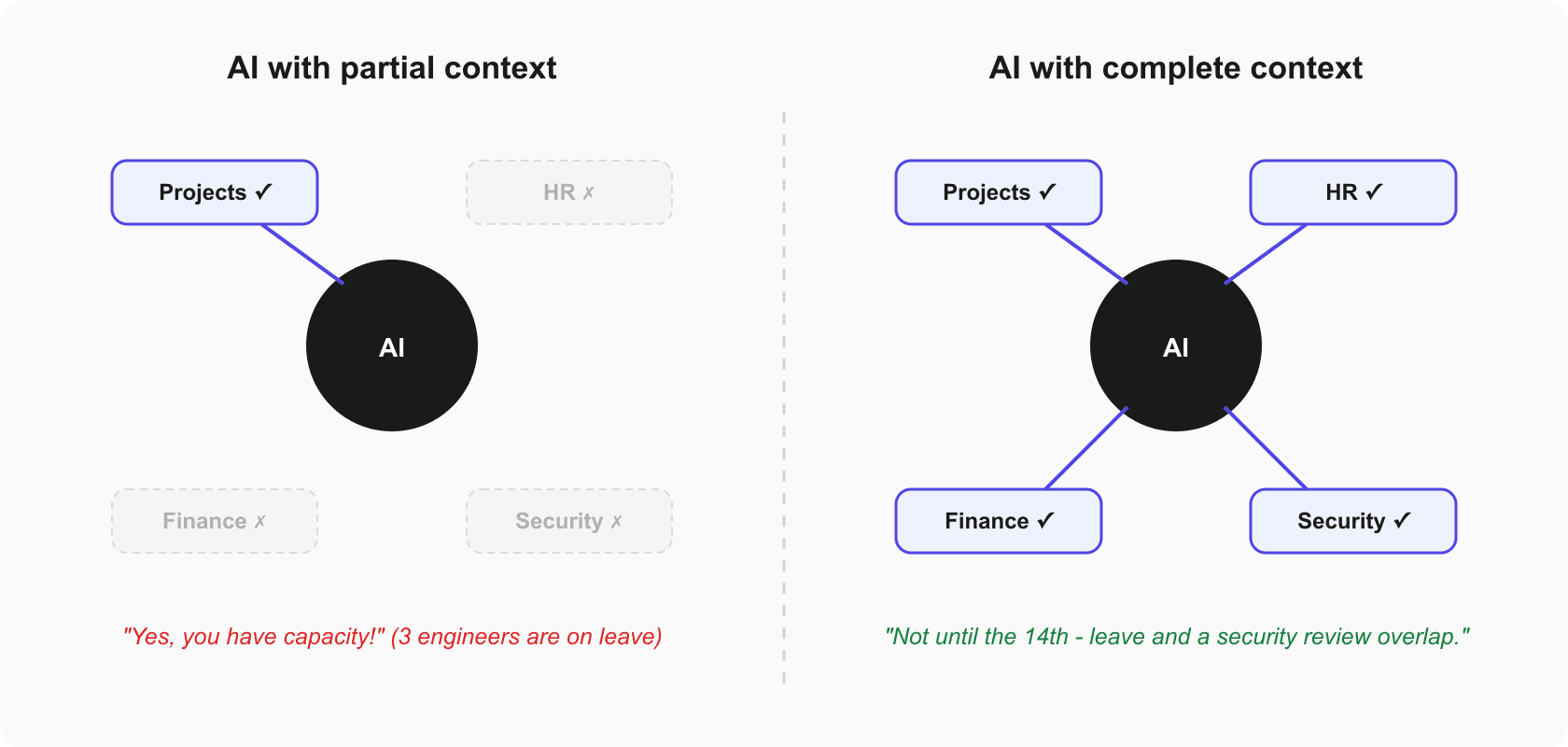
> Key takeaway: AI quality is capped by context, not model choice. Before asking "which model?", ask "what can it see?" - breadth, liveness and the ability to act are what turn AI answers into ones you can trust.
Why the usual workarounds fall short
Copy-paste context. Users paste documents and exports into a chat window. It works for one-off questions, but the context is stale the moment it's pasted, and the burden of assembling it sits with the human - the opposite of automation.
Retrieval over a document dump. Indexing your files for search-and-retrieve helps with knowledge questions, but documents are only one kind of context. They can't tell the AI who's on leave today, what's blocked in the sprint, or which invoice is overdue. Live operational state doesn't live in PDFs.
Per-tool AI assistants. Every SaaS product now ships a built-in copilot. Each one is competent inside its own walls and blind beyond them - you end up with ten partial assistants instead of one useful one. (We compare these approaches in AI Assistants vs AI Operating Systems.)
What complete context actually means
Complete business context has three properties that document search alone can't provide:
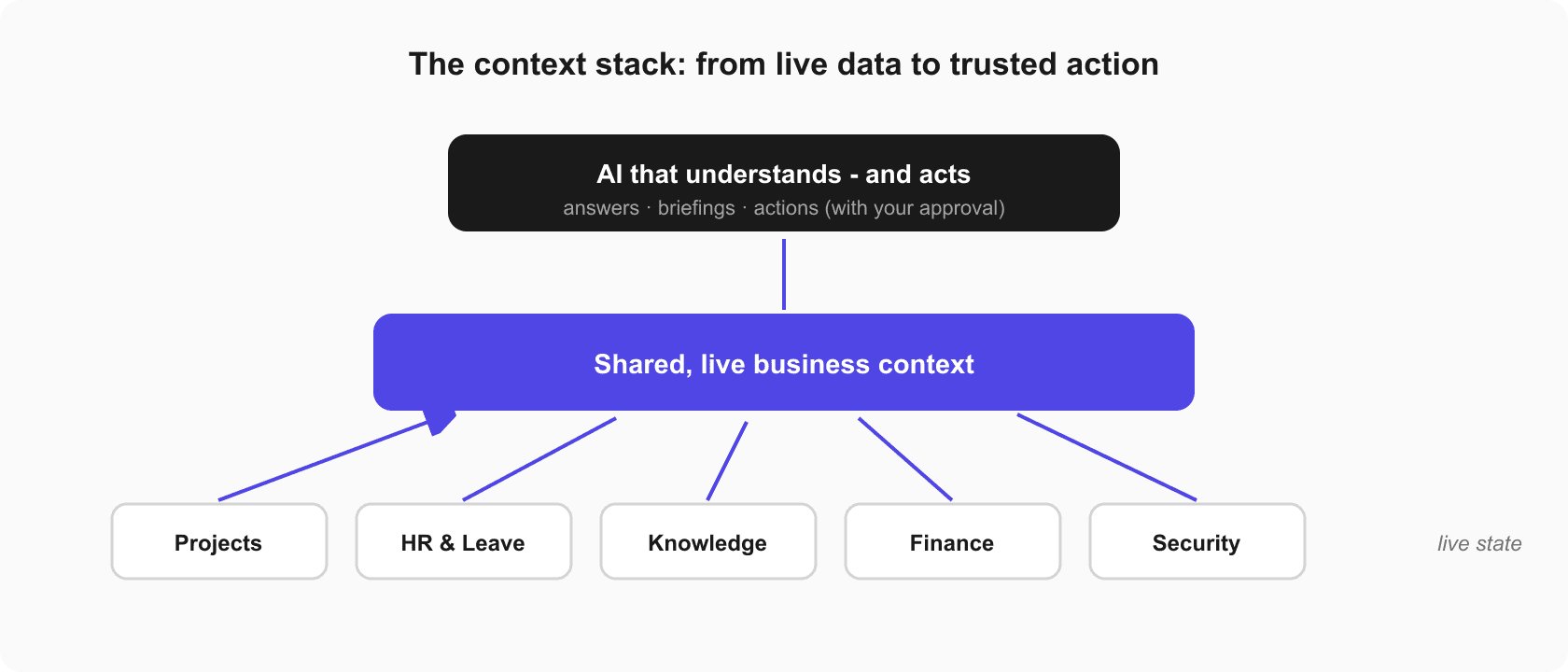
- Breadth - the AI can see across functions: projects, people, knowledge, finance, security. Real questions cross those boundaries constantly.
- Liveness - the AI reads current state, not an export from last Tuesday. "Who's out today?" needs today's data.
- Actionability - the AI can do something with what it sees: create the task, approve the request, draft the invoice - with human confirmation on every write.
Two routes to complete context
There are two practical ways to give AI this kind of visibility. The first is connect everything: keep your existing tools and expose them to AI through a standard interface - this is what the Model Context Protocol (MCP) was designed for. The second is consolidate: run your core operations on a unified platform, so the context is complete by construction rather than by integration.
They're complementary - and Hplix does both. Because Hplix runs projects, communication, knowledge, HR, security and operations in one platform, its AI command centre, Pulse, starts with live context from every module. And through Hplix MCP, any LLM you already use - Claude, ChatGPT, Gemini - can tap the same complete context, with your approval required on every write action.
The lesson from the first wave of enterprise AI is simple: don't ask "which model?" first. Ask "what can it see?"